AI Student Management System Features in SELMA SIS
The AI Student Information System built for education providers
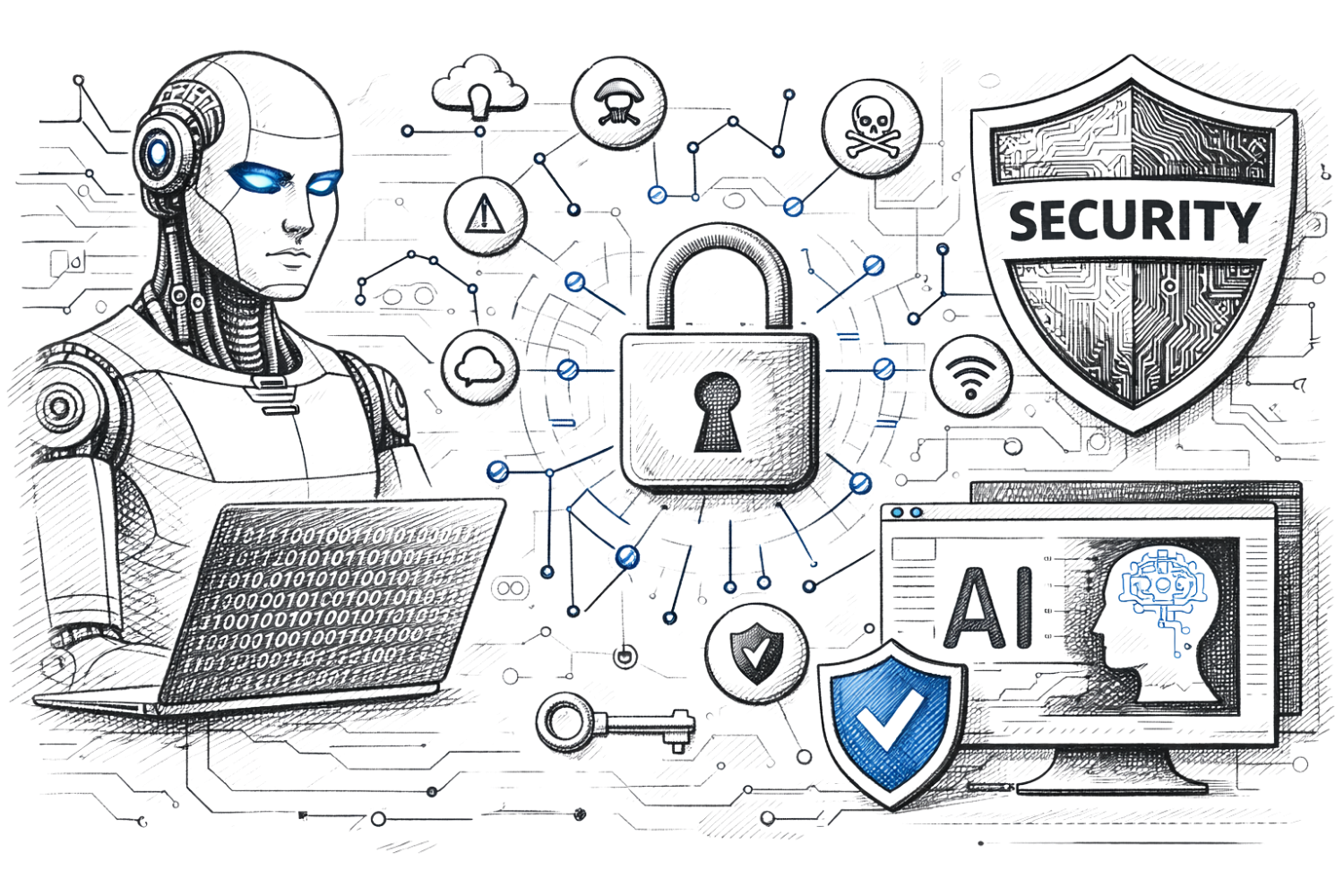
Safety-first approach to AI in education
We operate AI features within enclosed, controlled environments that prevent unauthorised data access or unintended information exposure. Student data never leaves our secure infrastructure without explicit institutional consent and appropriate data protection agreements. All AI-assisted operations maintain complete audit trails showing what data was processed, what recommendations were generated, and what actions were taken.
This matters because education is one of the most regulated and privacy-sensitive sectors. SELMA's AI is built for institutions that take their compliance obligations seriously, including GDPR, FERPA, the Australian Privacy Act, the New Zealand Privacy Act, and equivalent frameworks in other jurisdictions.
AI Workflow Builder
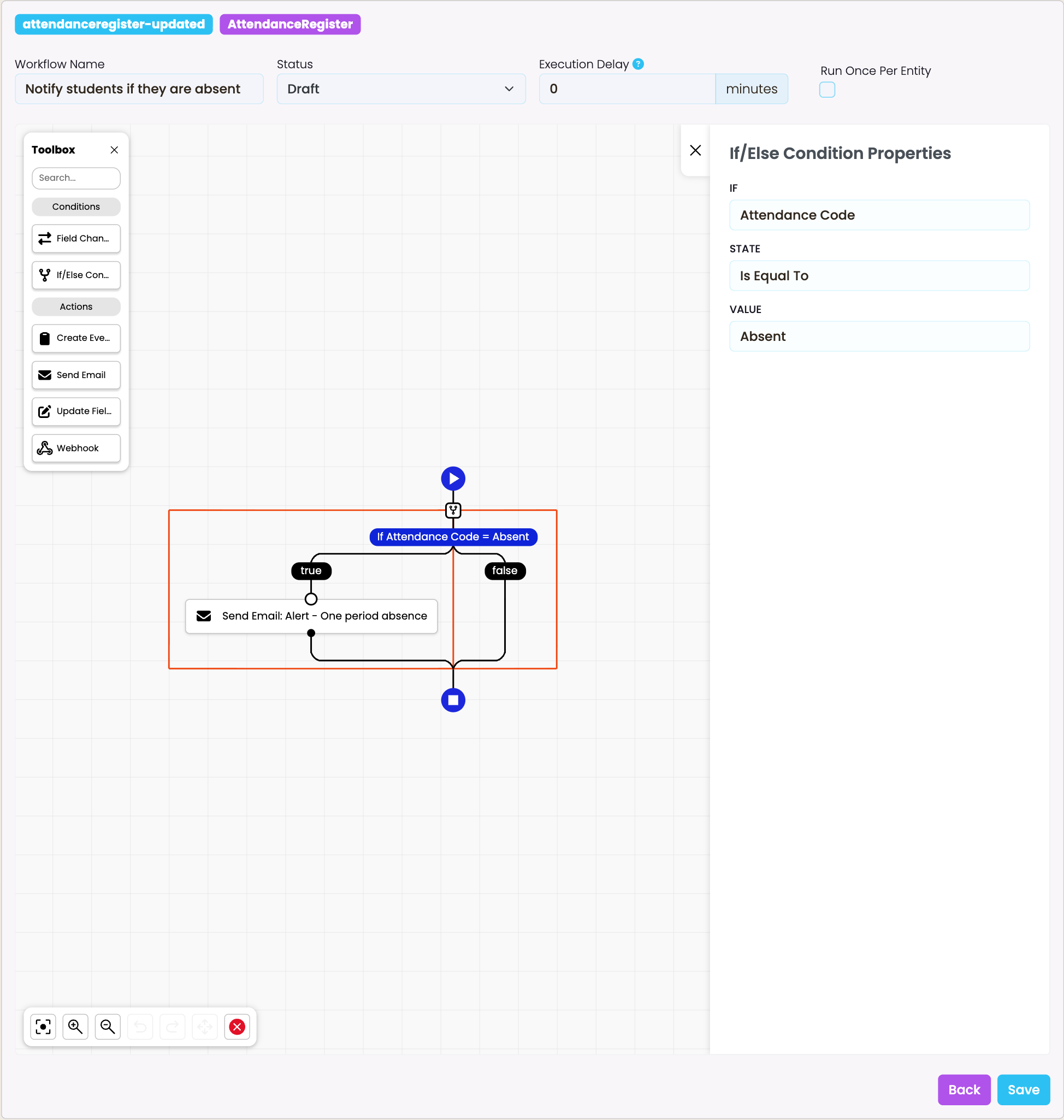
SELMA's AI-assisted workflow builder transforms plain English instructions into automated processes without requiring technical expertise or complex configuration. Describe what you want to achieve in everyday language such as "Send an email to parents if a student is marked absent in class" or "Create a task for the finance team when a payment is 14 days overdue", and the AI interprets your intent, identifies trigger conditions, determines appropriate actions, and builds the workflow logic automatically.
The AI analyses your instruction, maps it to available system triggers like attendance marking or payment due dates, identifies relevant data objects such as students, parents, or staff members, and constructs workflow steps including conditional logic, timing rules, and notification content. You review the generated workflow in a visual flowchart, make adjustments if needed, and activate it with confidence.
Every AI-generated workflow undergoes validation checks ensuring it will not create data conflicts, infinite loops, or unintended consequences. Over time, the AI learns your institutional terminology, common processes, and workflow patterns, making suggestions increasingly accurate and relevant whilst you maintain complete control over editing, testing, and approving every workflow before it affects real student data. This puts powerful automation capabilities in the hands of administrators rather than requiring technical specialists.
Conversational AI for your SELMA platform
Interact with SELMA the way you would with a knowledgeable colleague. Ask questions in plain English, request reports, pull up student records, draft communications, or trigger system actions through a conversational interface that understands your institutional context.
Rather than navigating menus and filters to answer a question like "Which students enrolled in the Diploma of Business have not completed their first assessment?", you ask the question and SELMA responds. The AI respects every permission boundary in your role-based access control, so users only see and act on data they are authorised to access. This conversational layer is the foundation of an AI education platform that genuinely augments staff capability rather than replacing institutional judgement.

MCP server integration for AI assistants
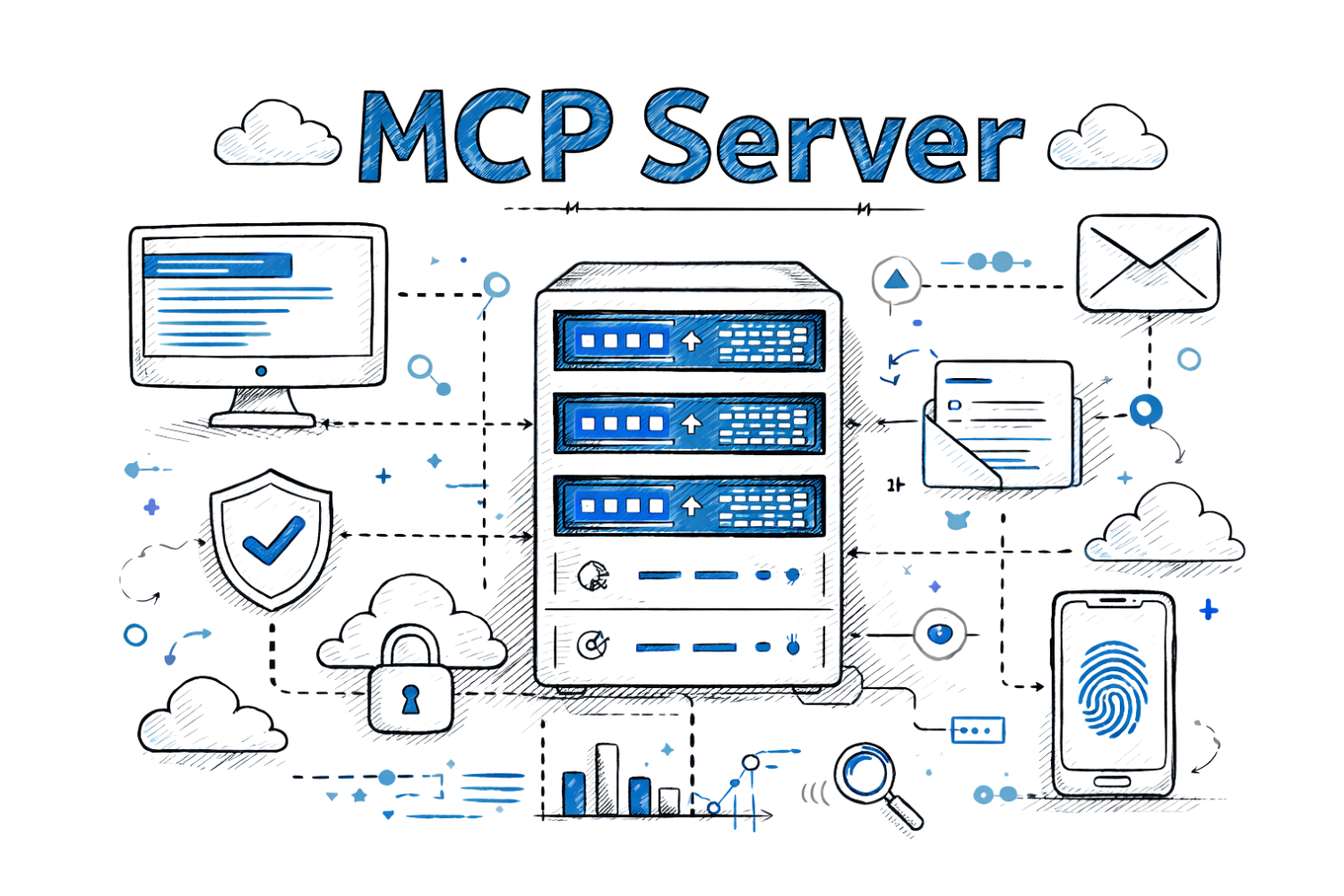
SELMA exposes a Model Context Protocol server, allowing your institution to connect SELMA securely to AI assistants and language models your team already uses, including Claude, ChatGPT, and Microsoft Copilot. Rather than copying data between systems or relying on unstructured screenshots, your AI tools query SELMA directly through a controlled, auditable interface.
This means staff can ask their preferred AI assistant questions about live SELMA data, generate documents that pull from current student records, or build custom integrations without needing direct API development. All access flows through SELMA's permission framework and audit logging, making this one of the few genuinely enterprise-ready AI integrations available in the education software market.
Intelligent email processing
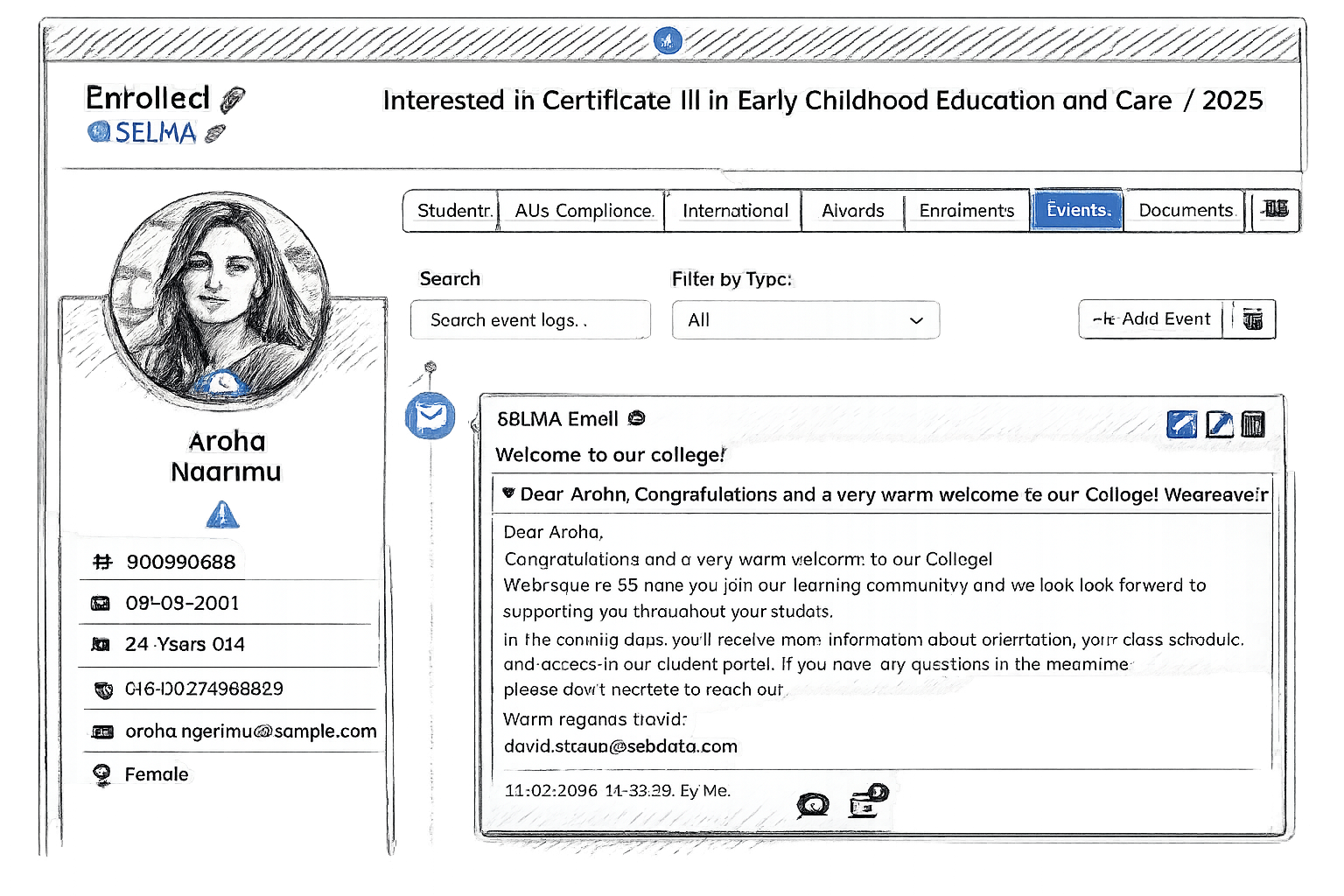
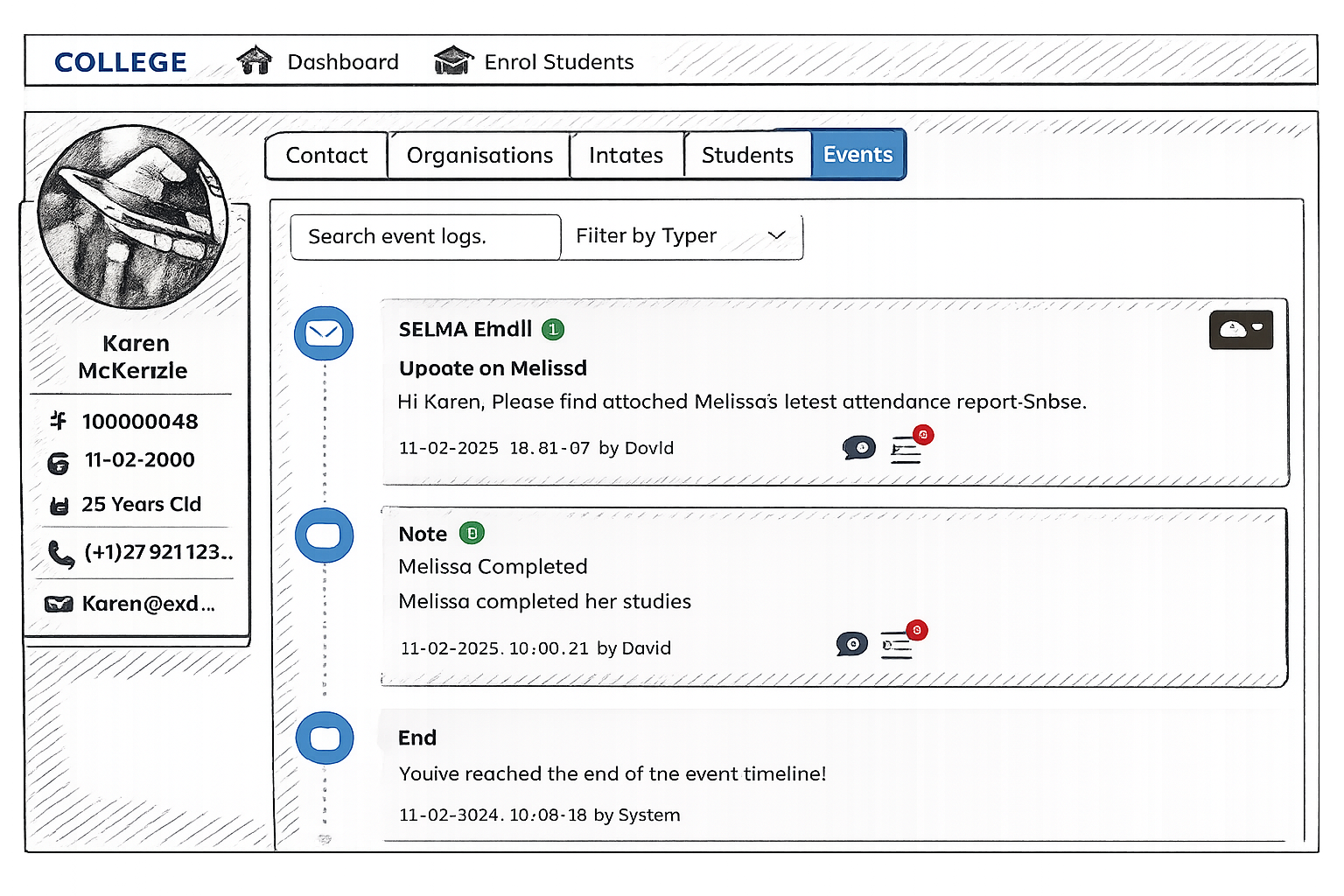
SELMA's AI email processing analyses inbound emails to your admissions, finance, or student services inboxes and routes them to the right place automatically. Student enquiries are linked to existing records or used to create new leads in the AI education CRM. Document attachments are categorised and filed against the relevant student profile. Urgent items are flagged for immediate human attention. Routine confirmations and replies can be drafted automatically for staff review before sending.
Email processing reduces the manual triage burden on admissions teams whilst ensuring nothing falls through the cracks during peak enrolment periods. It is particularly valuable for institutions handling high volumes of international applications, agent communications, and document submissions.
Interview and meeting transcription
Record and transcribe student interviews, employer meetings, and assessment conversations directly into SELMA. The AI generates accurate transcripts, summaries, and action items, then files them against the relevant student or contact record.
This is particularly valuable for providers documenting genuine student interviews for international enrolment, for trainers conducting competency conversations in work-based training, and for any process where the conversation itself is part of the compliance record. Transcripts remain within SELMA's secure environment and are subject to your retention and access policies.
AI Report Builder
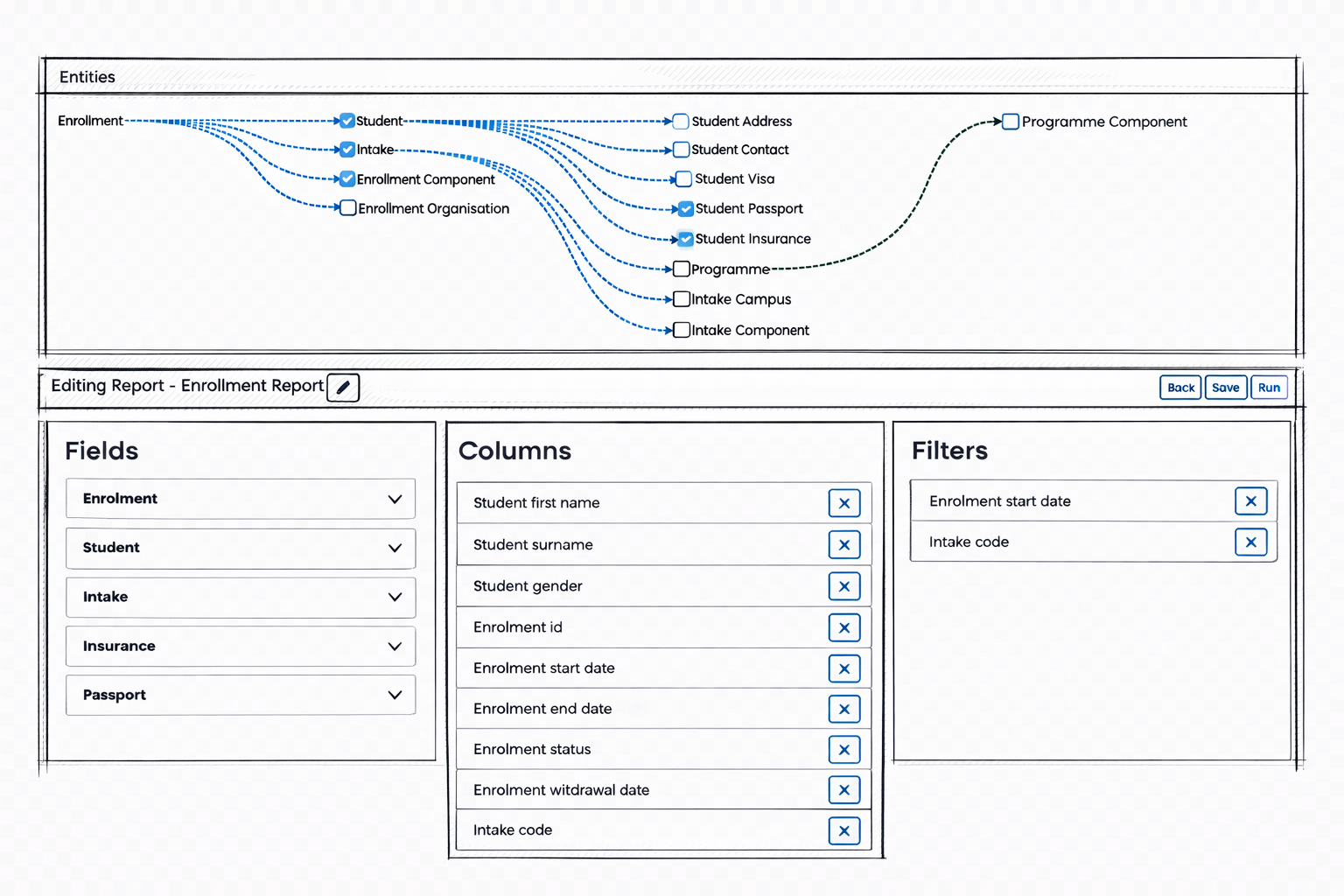
Generate complex reports by describing what you need rather than configuring filters and field selections manually. Ask for "a breakdown of completion rates by qualification and intake for the last 12 months, split by funding source" and the AI builds the report structure, applies the right filters, joins the relevant data objects, and presents the result. You review, refine, and save the report for ongoing use.
The AI report builder helps non-technical staff build reports that previously required a power user, external consultant, or expensive business intelligence platform. It is one of the clearest examples of how AI in a student information system can change the day-to-day reality for administrative staff.
Early access programme
SELMA's AI capabilities are evolving rapidly. Features described above are at varying stages of availability. Some are live for all SELMA customers, others are available to institutions participating in our early access programme. Early access customers work directly with the SELMA product team, give hands-on input into how features develop, and benefit from new capabilities ahead of general release.If you would like to participate in the early access programme or discuss AI features for your institution, contact the SELMA team to arrange a conversation.